When you're unconscious after an accident, you can't tell a doctor that penicillin nearly killed you last time, or that you're B-negative. Two small facts — your blood group and your allergies — sit at the very top of the list a responder needs, and getting them wrong can be fatal. Here's why they matter so much, and how a scannable tag puts them in a stranger's hands in seconds.
Why blood group comes first
In serious trauma — a road crash, a fall, heavy blood loss — a transfusion may be needed fast. Hospitals cross-match blood before transfusing, but in a genuine emergency knowing your group up front saves precious minutes and helps staff prepare the right units before you even reach the operating table.
This matters even more for people with rarer groups. If you're O-negative, AB-negative, or carry the Bombay blood group that's disproportionately found in parts of India, hospitals may need to source compatible units from a blood bank — and the sooner they know, the sooner that search begins. A tag that surfaces your group on the first scan can start that clock earlier than any conversation could.
Group compatibility is not optional. Give an A-positive patient the wrong type and the immune system attacks the transfused cells — a reaction that can cause kidney failure, shock, and death. That is why a verified blood group on your person, visible the instant someone scans your tag, is one of the most valuable things you can carry.
You can't shout your blood group when you're unconscious. Your tag can — the moment someone scans it.
Allergies: the silent, deadly detail
Allergies are the second half of the story, and they're just as dangerous when unknown. A well-meaning paramedic or hospital gives a routine drug — an antibiotic, a painkiller, an anaesthetic — and if you're allergic, the result can be anaphylaxis: swelling, a crashing blood pressure, and a closed airway within minutes.
In India, penicillin-class antibiotics, sulpha drugs, NSAIDs like diclofenac, and certain anaesthetic agents are common culprits. Food and sting allergies matter too — but in a hospital setting, it's the wrong drug that most often does harm because staff have no way to know your history.
The details that belong on your tag
- Blood group — including the Rh factor (positive or negative).
- Drug allergies — name the drug or class, e.g. "penicillin", "sulpha", "aspirin".
- Severe food or sting allergies — anything that has caused anaphylaxis before.
- Chronic conditions that change treatment — diabetes, epilepsy, asthma, heart disease.
- Current critical medications — blood thinners like warfarin are especially important before any surgery.
Not sure what else to include? Our guide to what information should be on a medical ID tag walks through every field, and why each one earns its place.
Why "written on paper" isn't enough
People try. A note in a wallet, a scribble on a helmet, a card that fades and tears. The problem is that paper is easy to miss, easy to lose, and impossible to update. A responder rifling through a stranger's bag at a crash site may never find it.
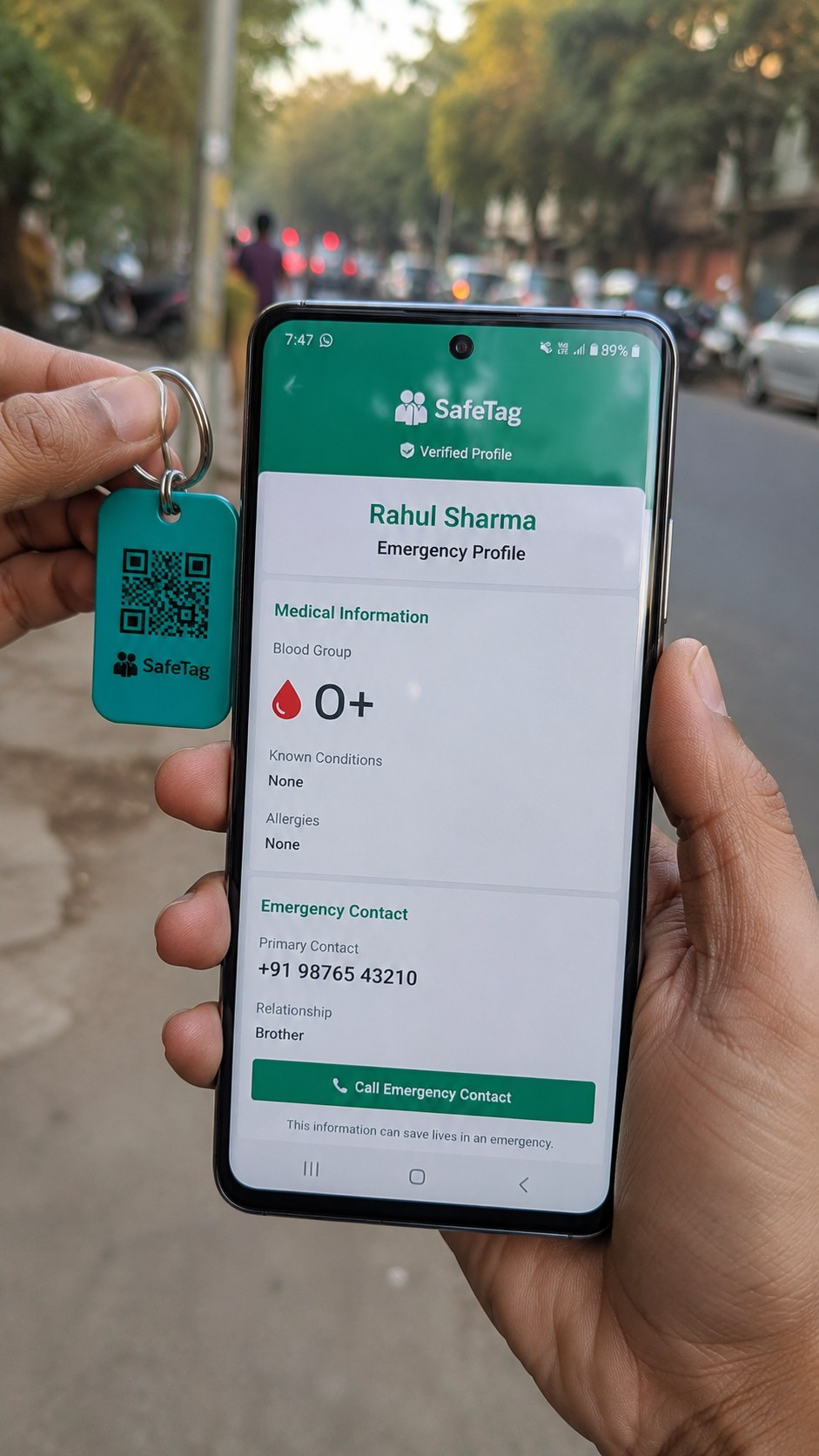
A SafeTag QR + NFC tag solves this. It's fixed to something the person carries — a wristband, a keychain, a helmet clip — and a responder simply scans it with any phone. In about three seconds your blood group and allergies appear on screen, no app to install. Those three seconds can decide everything, which is exactly why the first minutes after an emergency matter so much.
Accurate today, accurate next year
Medical facts change. You develop a new allergy, start a blood thinner, get a confirmed blood group after a test. A printed card can't keep up. Because your SafeTag profile is digital, you update it anytime and every future scan shows the current information — no reprinting, no reordering.
Privacy without the risk
Sharing medical details makes some people nervous, and rightly so. SafeTag is built so your profile isn't public and can't be searched online — it only opens when your physical tag is scanned. You choose which fields to show, and contact numbers are revealed on tap rather than printed in plain text, so casual scrapers get nothing. New to how it all works? Start with how SafeTag works.
Blood group and allergies are the two facts most likely to change what a responder does — and the two most likely to be missing when it counts. Putting them on a tag you always carry is one of the simplest, highest-value safety decisions you can make for yourself and your family.