
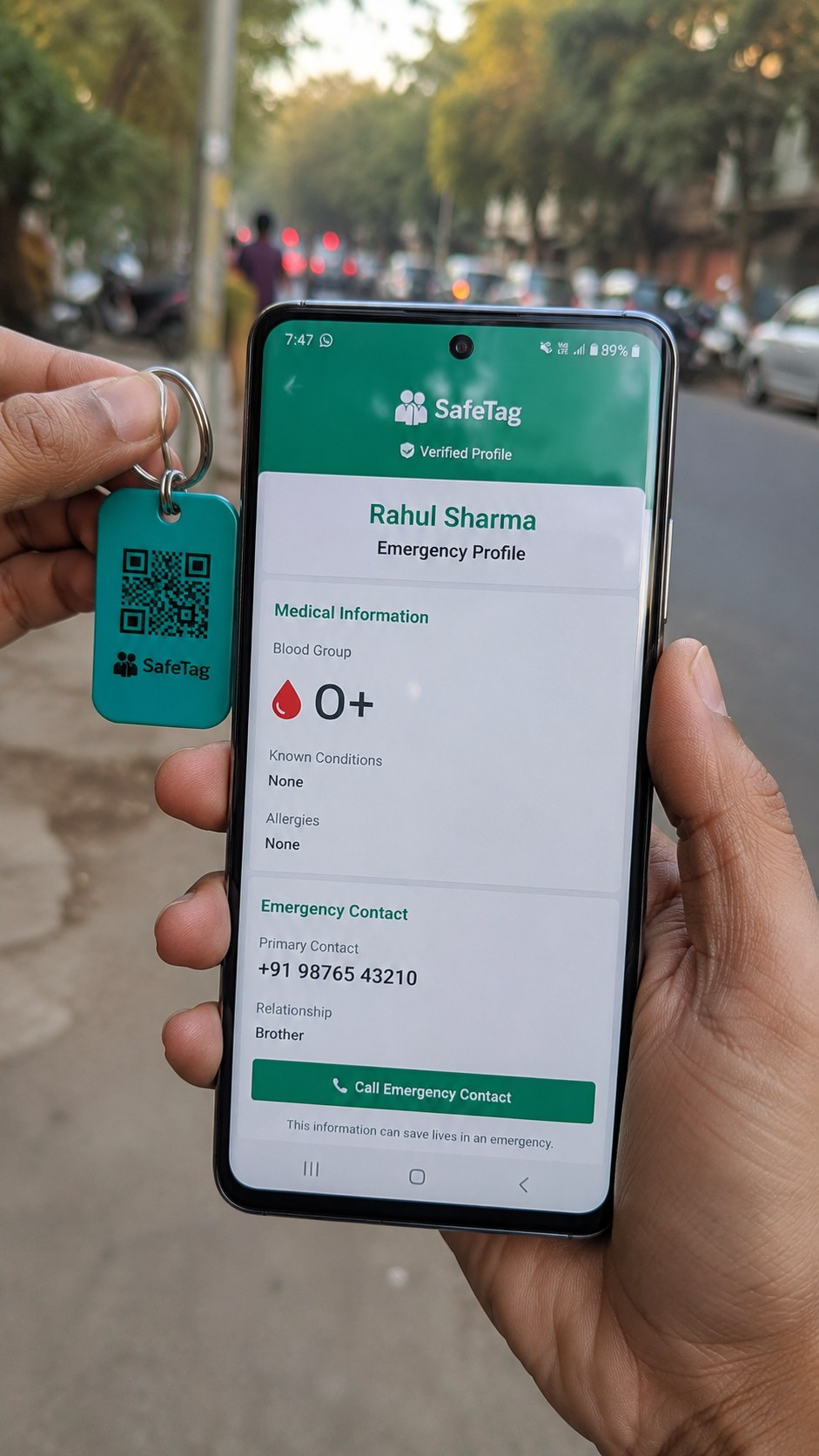
If you're shopping for an emergency ID tag, you'll hear two words a lot: QR and NFC. Both let a stranger's phone pull up your emergency profile in seconds — but they work in completely different ways, and each shines in different situations. Here's a plain-English comparison, and why the smartest tags don't make you choose.
How a QR code works
A QR code is that square black-and-white pattern you've scanned a thousand times for menus and UPI payments. To use one, a helper opens their phone camera, points it at the code, and taps the link that pops up. That link opens your emergency profile in the browser — no app needed.
Because QR is just a printed pattern, it works on every smartphone made in the last decade, costs almost nothing to produce, and can be read from a short distance — even from a photo of the tag.
How NFC works
An NFC chip (Near-Field Communication) is the same technology behind tap-to-pay cards. A tiny chip sits inside the tag with no battery. When a phone touches it, the phone reads the chip and opens your profile — often without even unlocking the camera app. It's the fastest, most "magical" option: just tap and go.
Because the chip draws its power from the phone itself, there's nothing to charge and nothing to run flat. It sits sealed and silent inside the tag for years, then springs to life for a fraction of a second the instant a phone comes close. That reliability is part of why NFC has become the standard for everything from metro cards to hotel keys.
QR is the code everyone already knows how to scan. NFC is the tap that needs no thinking at all.
Pros and cons at a glance
QR code — strengths and limits
- Works on virtually any phone, old or new
- Readable from a distance, and even from a photograph
- Extremely cheap and easy to reprint
- Can fade, smudge or tear if the tag is low quality
- Needs the helper to open the camera and tap a link
NFC — strengths and limits
- Fastest possible experience — one tap, no camera
- Nothing printed to scratch or fade; the chip is sealed inside
- Feels effortless for people who already use tap-to-pay
- Requires an NFC-capable phone (most mid-range and above)
- Needs close contact — the phone must physically touch the tag
So which is better for an emergency?
Here's the honest answer: in a real emergency, you cannot predict who will find your loved one or what phone they'll be holding. It might be a passer-by with a five-year-old handset, a paramedic in a hurry, or a shopkeeper who's never tapped an NFC tag in their life. Relying on only one technology means relying on luck.
That's exactly why SafeTag builds both into every tag. The NFC chip gives a fast, effortless tap for modern phones, and the printed QR code guarantees that any smartphone can still reach the profile. Whoever finds the tag uses whichever is quicker — and the information they see is identical either way. To see that dual system end to end, read how SafeTag works in 3 steps.
The same tag, many jobs
Building on both QR and NFC also makes the tag far more versatile than a medical ID alone. The same scan-or-tap action can open a digital visiting card, a lost-and-found page for a pet or a bag, a product page, or a review link. We collected our favourite ideas in 8 smart uses for a QR + NFC tag beyond medical.
What to look for when you buy
Whichever technology matters most to you, the quality of the physical tag decides whether it survives real life. Look for:
- A tag that carries both QR and NFC, not one or the other
- Durable, water-resistant material for keychains, wristbands and helmets
- A profile you fully control, with numbers revealed only on tap
- No app required for the person scanning
- The freedom to update your profile without reprinting the tag
Price shouldn't force a compromise either. Because both technologies are inexpensive to produce, a well-made dual tag costs little more than a single-mode one — so there's rarely a good reason to settle for QR-only or NFC-only.
You'll find durable QR + NFC tags built exactly this way in the SafeTag store — one tag, both technologies, no compromise.